View All ISO-9001-Lead-Auditor Actual Exam Questions, Answers and Explanations for Free [Q19-Q43]

View All ISO-9001-Lead-Auditor Actual Exam Questions, Answers and Explanations for Free

ISO-9001-Lead-Auditor Exam Free Practice Test with100% Accurate Answers

PECB ISO-9001-Lead-Auditor Exam Syllabus Topics:

Topic Details
Topic 1
  • Fundamental principles and concepts of a quality management system: The main objective of this domain is to evaluate your skills of explaining and applying ISO 9001 principles and concepts.
Topic 2
  • Fundamental audit concepts and principles: Questions about interpreting and applying the main concepts and principles related to a QMS audit appear in this topic.
Topic 3
  • Closing an ISO 9001 audit: The topic focuses on concluding a QMS audit and conducting audit follow-up activities.
Topic 4
  • Conducting an ISO 9001 audit: It evaluates your skills to conduct a QMS audit.
Topic 5
  • Managing an ISO 9001 audit program: This topic evaluates your abilities to establish and managing a QMS audit program.


Q19. Which one of the following options is the definition of the context of an organisation?


Q20. According to ISO 19011, what two activities take place during the conduct of a audit follow-up?


Q21. In the context of a third-party audit, match the activity with the party responsible in relation to the audit process.

Q22. An audit team of three people is conducting a Stage 2 audit to ISO 9001 of an engineering organisation which manufactures sacrificial anodes for the oil and gas industry in marine environments. These are aluminium products designed to prevent corrosion of submerged steel structures. As one of the auditors, you find that the organisation has shipped anodes for Project DK in the Gulf of Mexico before the galvanic efficiency test results for the anodes have been fully analysed and reported as required by the customer. The Quality Manager explains that the Managing Director authorised the release of the anodes to avoid late delivery as penalties would be imposed. The customer was not informed since the tests rarely fall below the required efficiency. You raise a nonconformity against clause 8.6 of ISO 9001.
During the audit team meeting in preparation for the Closing meeting, the second auditor disagreed with the clause of ISO 9001 selected for the above nonconformity. He thinks it should be clause 9.1.1.
Choose three options for how the audit team leader should best respond to the situation:


Q23. Scenario 3:
Fin-Pro is a financial institution in Austria offering commercial banking, wealth management, and investment services. The company faced a significant loss of customers due to failing to improve service quality as they expanded.
To regain customer confidence, top management implemented a QMS based on ISO 9001. After a year, they contacted ACB, a local certification body, to pursue ISO 9001 certification.
The audit team was led by Emilia, an experienced lead auditor, and included three auditors. After an agreement was reached, ACB sent the audit objectives to the audit team.
The audit team began by gathering information about Fin-Pro’s understanding of ISO 9001 requirements.
While reviewing documented information, they noticed missing records of training and awareness sessions. They conducted employee interviews to verify attendance.
The team also reviewed the organizational chart and job descriptions to confirm employee competence.
They observed the company’s working environment (social, psychological, and physical conditions).
The audit team analyzed the evidence and prepared an audit report with findings and conclusions.
What type of evidence has been collected by the ACB’s audit team, as presented in scenario 3?


Q24. How can an organization ensure the objectivity and impartiality of the internal audit function?


Q25. Scenario 1: AL-TAX is a company located in California which provides financial and accounting services. The company manages the finances of 17 companies and now is seeking to expand their business even more The CEO of AL-TAX, Liam Durham, claims that the company seeks to provide top- notch services to their clients Recently, there were a number of new companies interested in the services provided by AL-TAX.
In order to fulfill the requirements of new clients and further improve quality, Liam discussed with other top management members the idea of implementing a quality management system (QMS) based on ISO 9001. During the discussion, one of the members of the top management claimed that the size of the company was not large enough to implement a QMS. In addition, another member claimed that a QMS is not applicable for the industry in which AL TAX operates. However, as the majority of the members voted for implementing the QMS. Liam initiated the project.
Initially, Liam hired an experienced consultant to help AL-TAX with the implementation of the QMS.
They started by planning and developing processes and methods for the establishment of a QMS based on ISO 9001. Furthermore, they ensured that the quality policy is appropriate to the purpose and context of AL TAX and communicated to all employees. In addition, they also tried to follow a process that enables the company to ensure that its processes are adequately resourced and managed, and that improvement opportunities are determined.
During the implementation process, Liam and the consultant focused on determining the factors that could hinder their processes from achieving the planned results and implemented some preventive actions in order to avoid potential nonconformities Six months after the implementation of the QMS.
AL-TAX conducted an internal audit. The results of the internal audit revealed that the QMS was not fulfilling all requirements of ISO 9001. A serious issue was that the QMS was not fulfilling the requirements of clause 5.1.2 Customer focus and had also not ensured clear and open communication channels with suppliers.
Throughout the next three years, the company worked on improving its QMS through the PDCA cycle in the respective areas. To assess the effectiveness of the intended actions while causing minimal disruptions, they tested changes that need to be made on a smaller scale. After taking necessary actions, AL-TAX decided to apply for certification against ISO 9001.
Based on the scenario above, answer the following question:
According to scenario 1, AL-TAX determined the factors that could hinder their processes from achieving the planned results and implemented preventive actions. This means they employed:


Q26. Match the process descriptions below to the process names:

Q27. Match the process descriptions below to the process names:

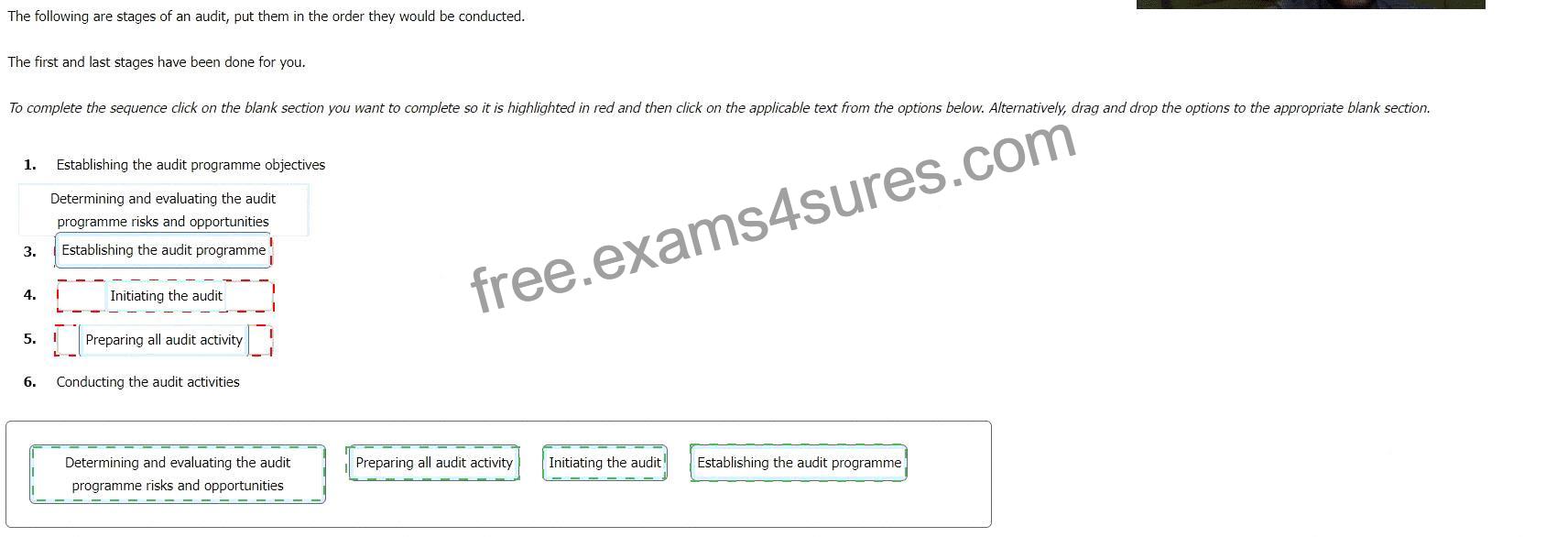
Q28. The following are stages of an audit, put them in the order they would be conducted.

Q29. Among others, what does Clause 4.4 (Quality Management System and Its Processes) of ISO 9001 require from organizations?


Q30. Scenario 3:
Fin-Pro is a financial institution in Austria offering commercial banking, wealth management, and investment services. The company faced a significant loss of customers due to failing to improve service quality as they expanded.
To regain customer confidence, top management implemented a QMS based on ISO 9001. After a year, they contacted ACB, a local certification body, to pursue ISO 9001 certification.
The audit team was led by Emilia, an experienced lead auditor, and included three auditors. After an agreement was reached, ACB sent the audit objectives to the audit team.
The audit team began by gathering information about Fin-Pro’s understanding of ISO 9001 requirements.
While reviewing documented information, they noticed missing records of training and awareness sessions.
They conducted employee interviews to verify attendance.
The team also reviewed the organizational chart and job descriptions to confirm employee competence. They observed the company’s working environment (social, psychological, and physical conditions).
The audit team analyzed the evidence and prepared an audit report with findings and conclusions.
ACB sent the audit objectives to the audit team after an agreement was reached. Is this acceptable?


Q31. You are carrying out an audit at a single-site organisation seeking certification to ISO 9001 for the first time.
The organization manufactures cosmetics for major retailers and the name of the retailer supplied appears on the product packaging. Sales turnover has increased significantly over the past five years.
You are interviewing the new Product Development Manager. You note that a software application called SWIFT is used to help control the product development process.
You have gathered audit evidence as outlined in the table. Match the ISO 9001 clause 8.3 extracts to the audit evidence.

Q32. You are conducting an audit at an organisation seeking certification to ISO 9001 for the first time. The organisation offers health and safety training to customers. Training courses are offered either as open courses, delivered at a public venue, or online, or as courses that are tailored to meet specific requirements.
The business operates from a single office and those who deliver the training are either full-time employees or subcontractors.
You have gathered audit evidence as outlined below. Match the ISO 9001 Clause 8 extract to the audit evidence.

Q33. The following are stages of an audit, put them in the order they would be conducted.

Q34. In the context of a management system audit, identify the sequence of a typical process for collecting and verifying information. The first one has been done for you.
To complete the sequence click on the blank section you want to complete so it is highlighted in red and then click on the applicable text from the options below. Alternatively, drag and drop the options to the appropriate blank section.

Q35. You are carrying out an audit at a single-site organisation seeking certification to ISO 9001 for the first time.
The organization manufactures cosmetics for major retailers and the name of the retailer supplied appears on the product packaging. Sales turnover has increased significantly over the past five years.
You are interviewing the new Product Development Manager. You note that a software application called SWIFT is used to help control the product development process.
You have gathered audit evidence as outlined in the table. Match the ISO 9001 clause 8.3 extracts to the audit evidence.

Q36. For each of the following scenarios, select four that are corrective actions.


Q37. Select the words that best complete the sentence:

Q38. An internal auditor of a manufacturer of polystyrene packaging products for the electronics industry raised a nonconformity against section 10.3 of ISO 9001 in Report IA202. The nonconformity (NC 3) stated:
“The reject rate of the finished product of 9.7% needs improvement as it doesn’t meet the stated objective of top management of 5%.” As the third-party auditor reviewing the internal audit process, you come across the nonconformity. For corrective action, the Quality Manager conducted an investigation into the reject rates. He reported that the collection baskets for products ejecting from the moulding machines were not large enough. About 6% of products fell onto the wet and dirty factory floor. Management stated that replacing the baskets was too costly and ordered the Maintenance Manager to ensure that the floor was kept clean and dry to prevent rejects. The auditor later checked the factory floor, which was wet and dirty in places.
From the following nonconformities, select three that the auditor could raise to ISO 9001.


Q39. What is a combined audit?


Q40. Scenario 3:
Fin-Pro is a financial institution in Austria offering commercial banking, wealth management, and investment services. The company faced a significant loss of customers due to failing to improve service quality as they expanded.
To regain customer confidence, top management implemented a QMS based on ISO 9001. After a year, they contacted ACB, a local certification body, to pursue ISO 9001 certification.
The audit team was led by Emilia, an experienced lead auditor, and included three auditors. After an agreement was reached, ACB sent the audit objectives to the audit team.
The audit team began by gathering information about Fin-Pro’s understanding of ISO 9001 requirements.
While reviewing documented information, they noticed missing records of training and awareness sessions. They conducted employee interviews to verify attendance.
The team also reviewed the organizational chart and job descriptions to confirm employee competence.
They observed the company’s working environment (social, psychological, and physical conditions).
The audit team analyzed the evidence and prepared an audit report with findings and conclusions.
Based on the last paragraph of scenario 3, which audit principle did the audit team follow?


Q41. You are carrying out an audit at a single-site organisation seeking certification to ISO 9001 for the first time.
The
organisation manufactures cosmetics for major retailers and the name of the retailer supplied appears on the product packaging. Sales turnover has increased significantly over the past five years. The organisation uses a software programme called SWIFT, which is used to record sales, plan production, purchase supplies, print despatch notes, track new product development, perform traceability exercises, carry out mass balance checks, raise invoices, create budgets, and support financial control.
You are nearing the end of the audit and you are reviewing your audit notes. You notice a recurring trend concerning the SWIFT database as shown below:

You ask the Quality Manager to explain how the SWIFT database is controlled. You learn that the Operations Director is responsible for determining and progressing SWIFT software updates. You decide to meet the Operations Director (OD).
You: “Good afternoon.”
OD: “Good afternoon.”
You: “What responsibility do you have concerning the SWIFT database?”
OD: “I maintain it. If anyone wishes to propose an update to the database, they send me an email with details of their proposal. I then either process the database update myself, or I send the request to the consultant who designed the database 20 years ago. The necessary software changes are made, and the amended software is immediately released to users.” You: “Would you explain how the software amendments are controlled?” OD: “Of course. I personally update every computer myself.” You: “Do you inform the database users of the changes?” OD: “No I don’t. They find out for themselves by using the software, or they come to see me if they have any questions.” You: “How do you ensure that the database users use the latest version?” OD: “That’s easy, I update every computer myself.” You: “During the audit, I noted there were several versions of SWIFT in use (you refer to your audit notes).” OD: “I know. That’s because some versions work better than others, and depending on user needs and experiences, we allow users to revert to using an earlier version if they find it works better for them.” Based on the scenario, which two of the following statements are true? There is evidence of nonconformity with a requirement defined in …


Q42. You have been nominated audit team leader of a third-party audit. Which of the following could be the two most relevant objectives of this audit?


Q43. Scenario 4:
TD Advertising is a print management company based in Chicago. The company offers design services, digital printing, storage, and distribution. As TD expanded, its management recognized that success depended on adopting new technologies and improving quality.
To ensure customer satisfaction and quality improvement, the company decided to pursue ISO 9001 certification.
After implementing the QMS, TD hired a well-known certification body for an audit. Anne Key was appointed as the audit team leader. She received a document listing the audit team members, audit scope, criteria, duration, and audit engagement limits.
Anne reviewed the document and approved the audit mandate. The certification body and TD’s top management signed the certification agreement.
Before contacting TD, Anne reviewed the audit scope and noticed that TD made changes to it due to the adoption of new printing equipment. However, Anne disagreed with the changes, stating they would affect the audit timeline. She considered withdrawing from the audit.
How do you assess the situation presented in the last paragraph of scenario 4?


ISO-9001-Lead-Auditor dumps Free Test Engine Verified By It Certified Experts: https://www.exams4sures.com/PECB/ISO-9001-Lead-Auditor-practice-exam-dumps.html


Rate this post

Related Links: www.slideshare.net www.notebook.ai parsif.al fortunetelleroracle.com www.slideshare.net scalar.usc.edu

Add a Comment

Your email address will not be published. Required fields are marked *

Enter the text from the image below